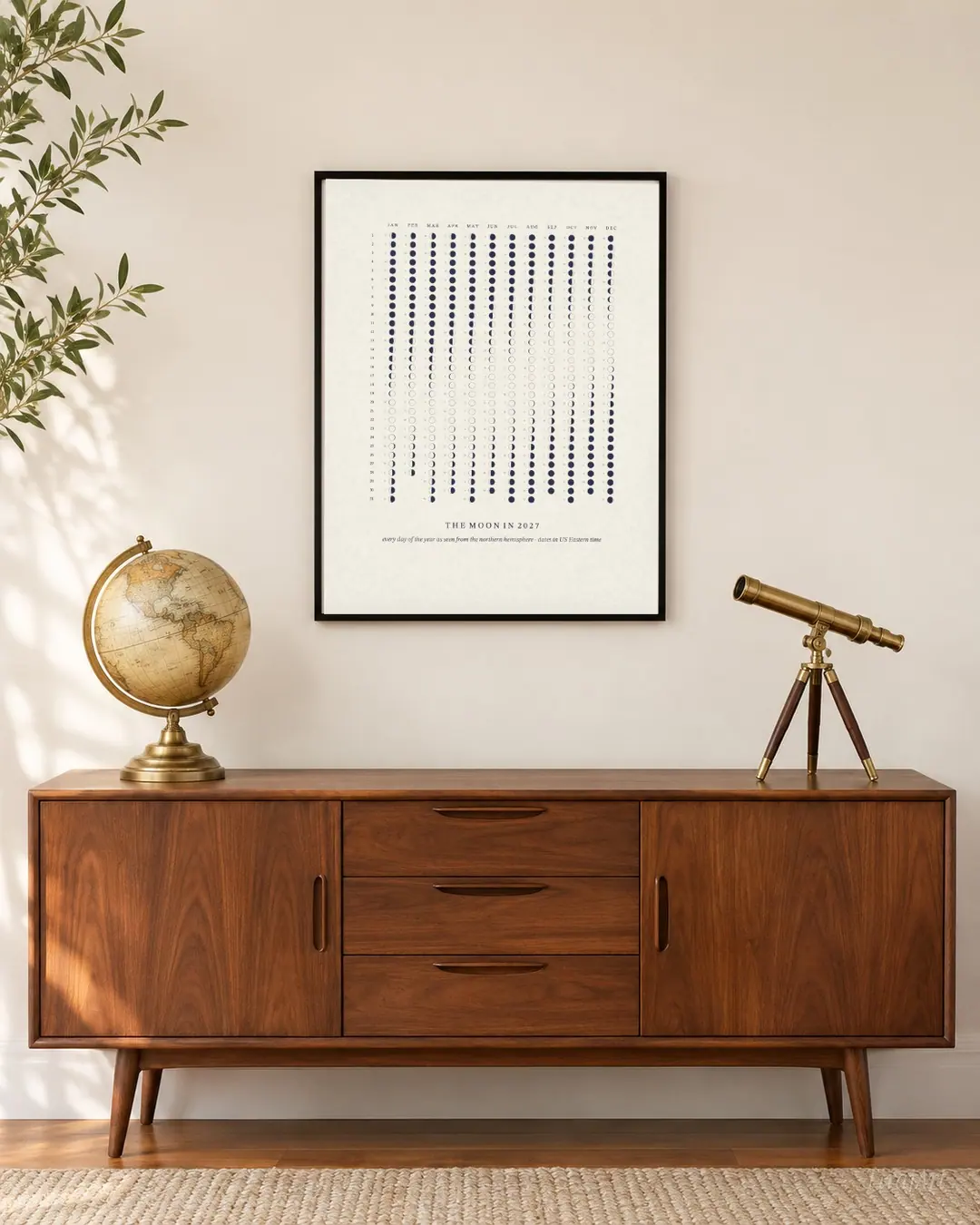
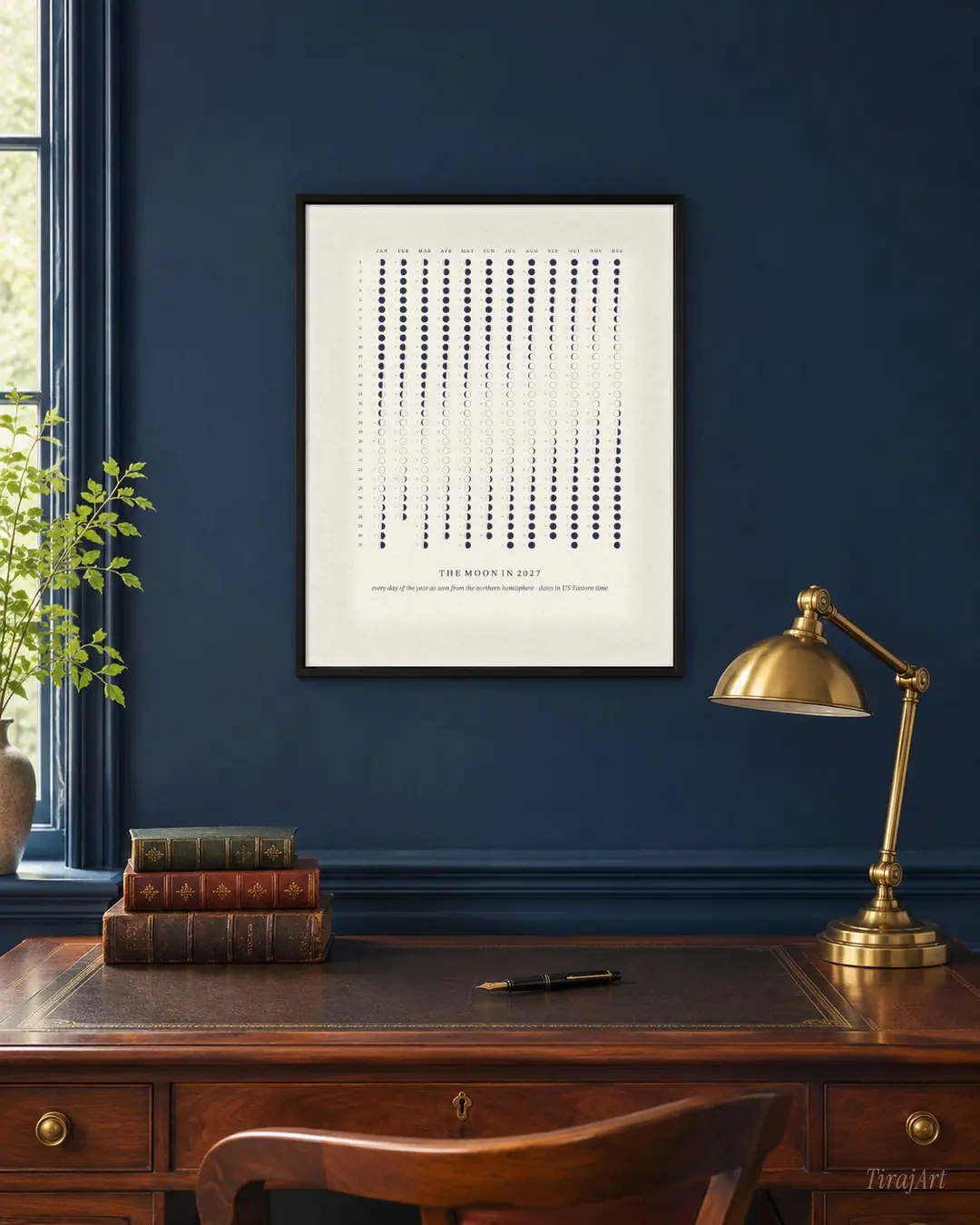
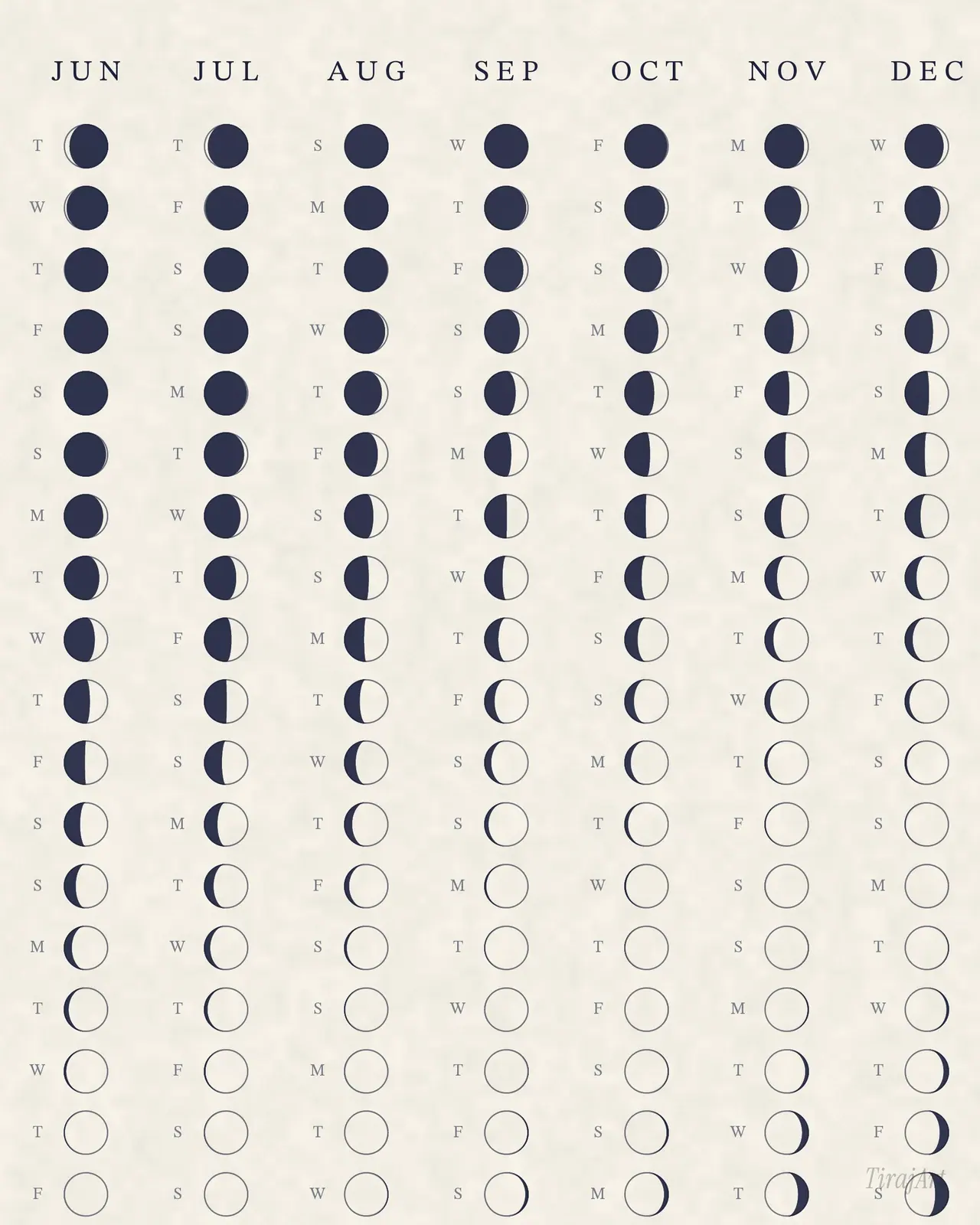
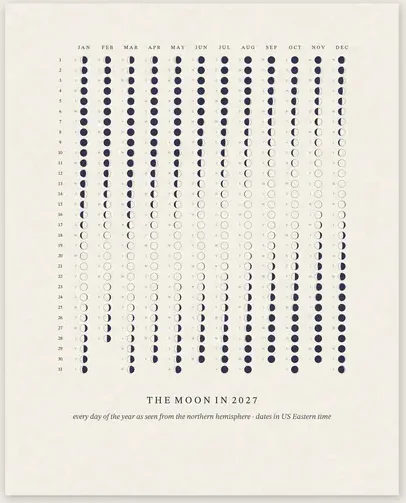
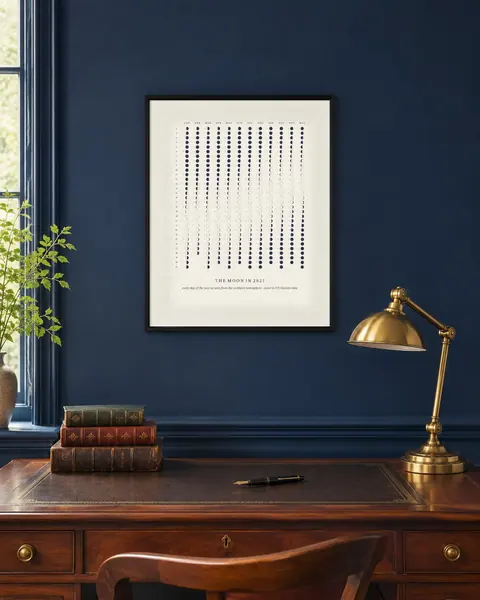
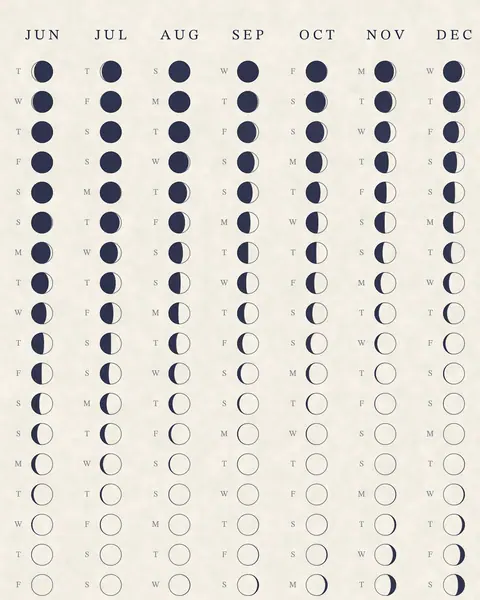
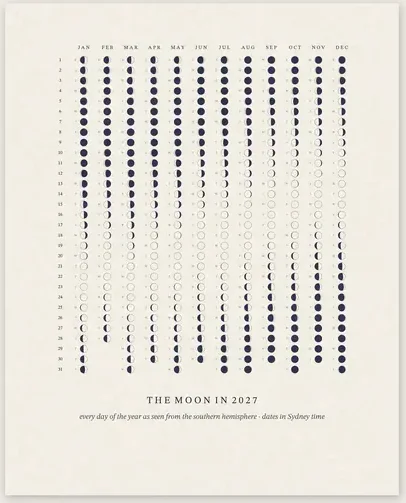
Every day of 2027 as the Moon will really look from the northern hemisphere: 365 small moons, one per day, computed from the astronomy rather than copied from a repeating icon. Read down a column and the Moon fills and empties month by month; read across and the full moons drift through the year.
Hemisphere and time zone
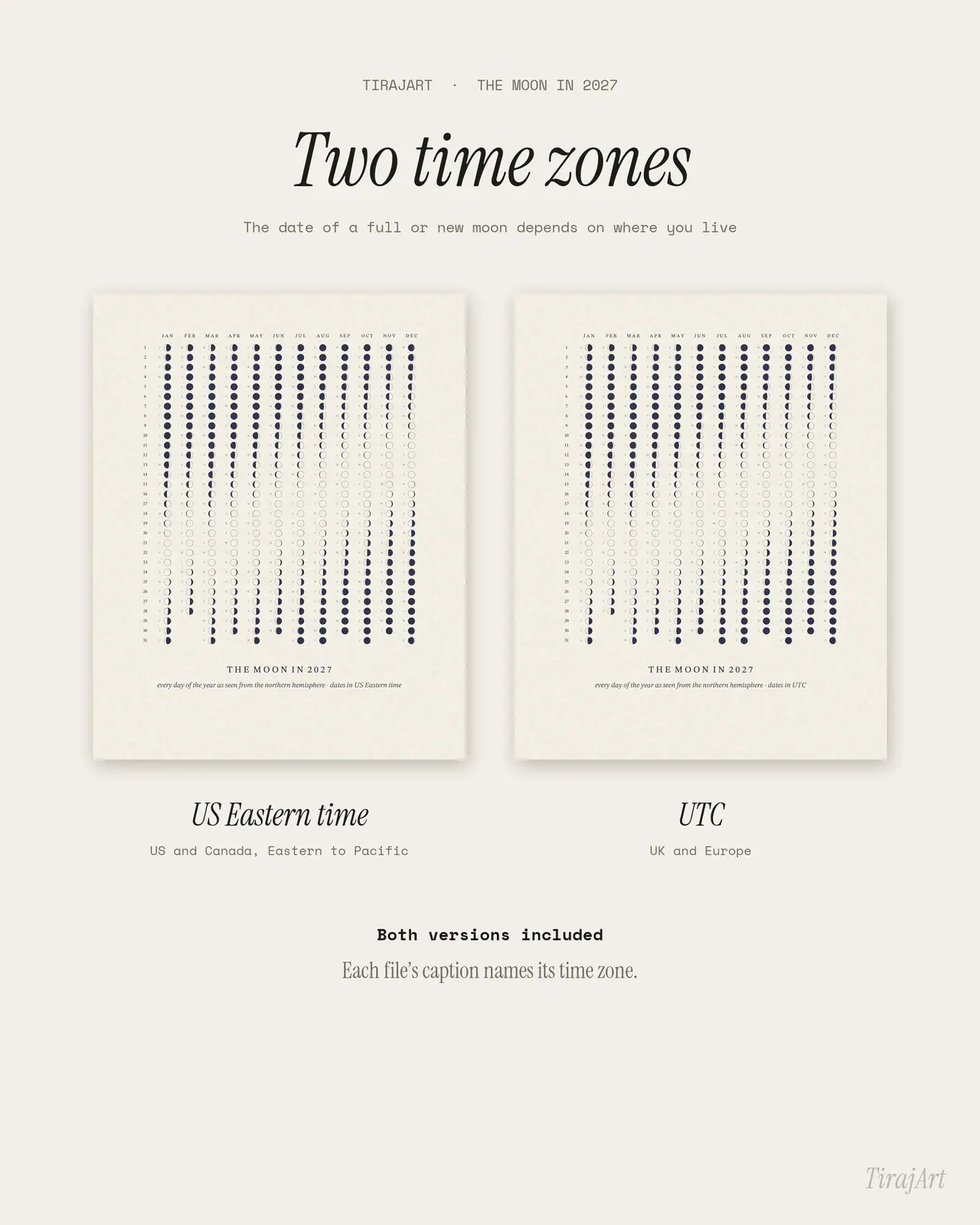
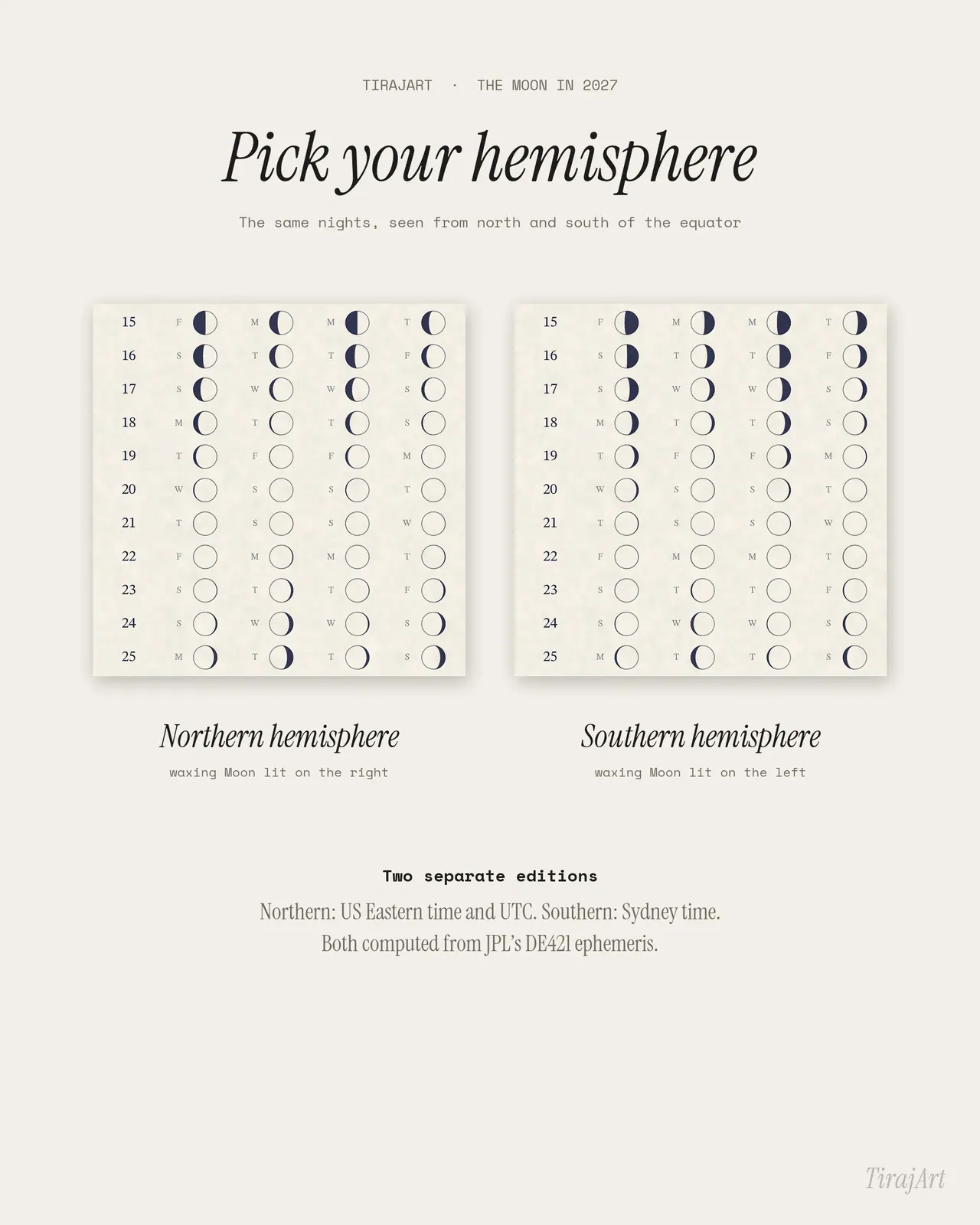
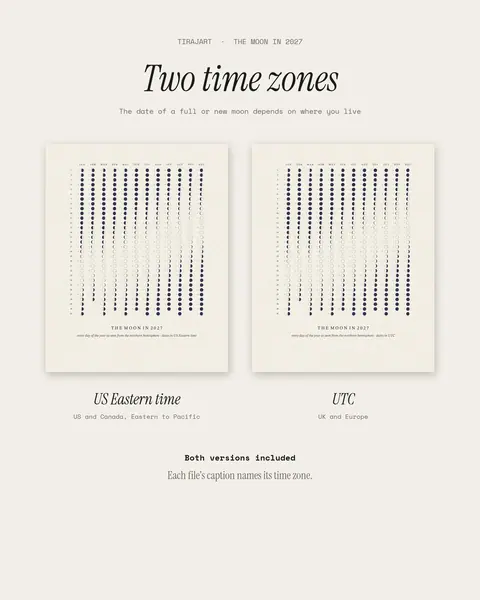
A full moon late in the evening in New York happens after midnight in London, so the date of each phase depends on where you live. You get two complete versions, and the caption on each file names its time zone:
- US Eastern time (New York). In 2027 every full and new moon falls on the same date in Eastern, Central, Mountain and Pacific time (Arizona and Saskatchewan included), so this version works across the contiguous US and Canada from Quebec to British Columbia; in Atlantic Canada one new moon falls a day later (Jul 4), in Newfoundland two (Jul 4 and Sep 30). Compared with UTC, five fall a day earlier: full moons on Jun 18 and Nov 13, new moons on Jul 3, Sep 29 and Nov 27.
- UTC, for the UK and Europe. A few phases happen just after midnight in European local time and so land a day later than drawn: in the UK two (new moon Apr 7, full moon Sep 16), in Central and Eastern Europe four (full moons Feb 21, Apr 21 and Sep 16, new moon Apr 7).
Within a few hours the Moon's shape barely changes, so every night reads the same; only the exact day of a phase can move.
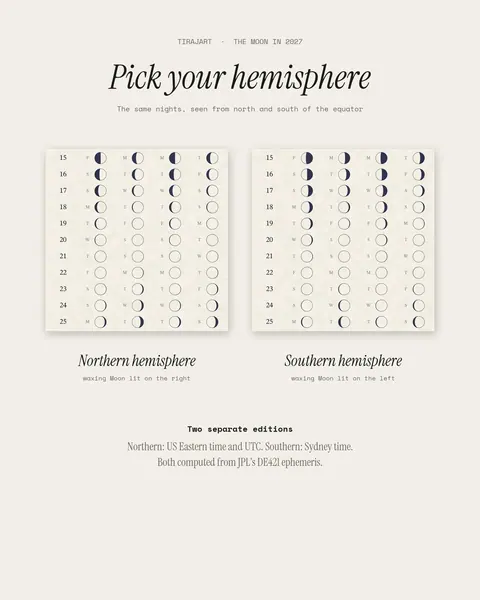
Drawn as seen from the northern hemisphere: the waxing Moon is lit on the right. For Australia, New Zealand, South America or southern Africa, choose our Southern Hemisphere edition.
The astronomy
Each Moon is computed for local noon of its day from the DE421 planetary ephemeris of the Jet Propulsion Laboratory (JPL), using the open-source Skyfield library: how much of the disc is lit, and whether the Moon is waxing or waning. Every new moon, first quarter, full moon and last quarter of 2027 was checked against the US Naval Observatory, Fred Espenak's published phase tables and timeanddate.com: all 49 phase times agree to within a minute, and all of them land on the same date in the chosen time zone.
The print
Drawn by Algo, the small program we wrote for our mathematics series. It draws each disc straight from the numbers, with no AI and no clip art, and lets the shadow build up like ink: deep navy on a warm cream sheet with a soft paper texture. Twelve columns for the months, 31 rows for the days, a small weekday letter beside every Moon. The cream sheet and the soft ink texture are printed into the file; print on white matte paper.
What’s included
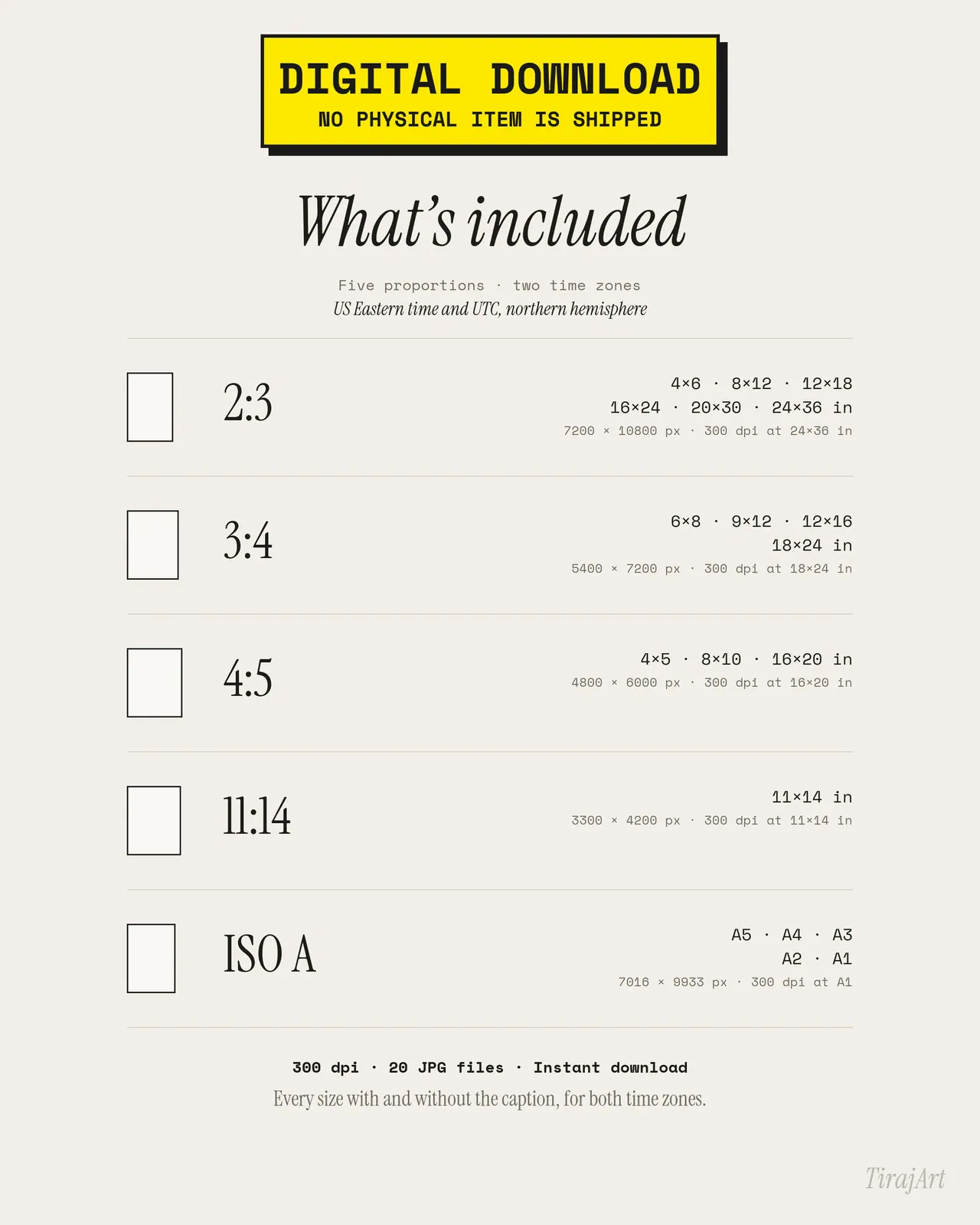
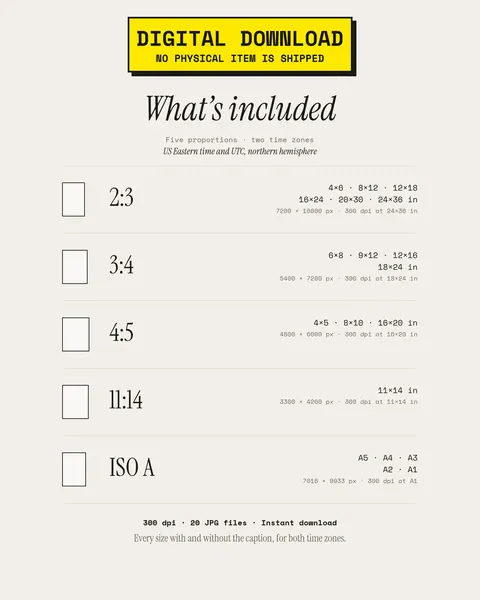
20 high-resolution JPEG files (sRGB): the five proportions below, each with and without the caption, in both time zones:
| Ratio | Print sizes | Pixels | Resolution |
|---|
| 2:3 | 4×6, 8×12, 12×18, 16×24, 20×30, 24×36 in | 7200×10800 px | 300 dpi at 24×36 in |
|---|
| 3:4 | 6×8, 9×12, 12×16, 18×24 in | 5400×7200 px | 300 dpi at 18×24 in |
|---|
| 4:5 | 4×5, 8×10, 16×20 in | 4800×6000 px | 300 dpi at 16×20 in |
|---|
| 11:14 | 11×14 in | 3300×4200 px | 300 dpi at 11×14 in |
|---|
| ISO A | A5, A4, A3, A2, A1 | 7016×9933 px | 300 dpi at A1 |
|---|
All files are 300 dpi at their largest size.
Each proportion comes twice: with the small caption under the calendar (it names the hemisphere and time zone), and plain.
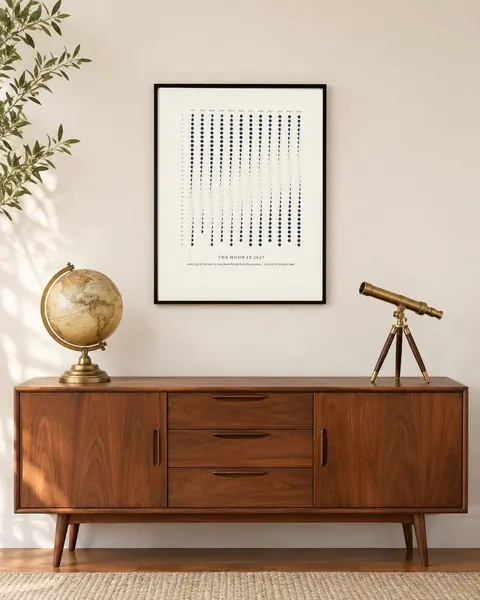
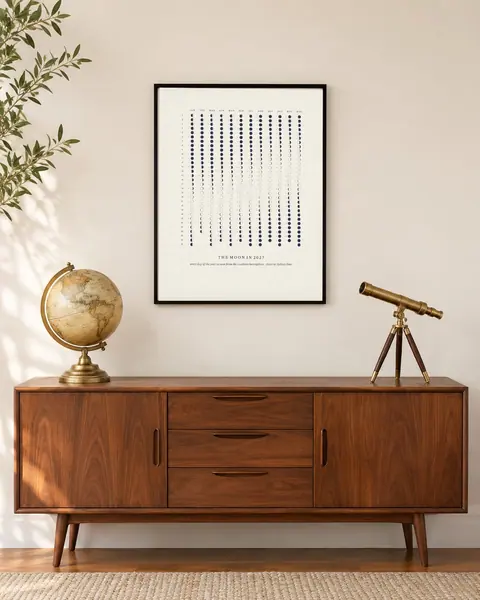
The calendar sits on the sheet with a wide paper margin, so the files frame well as they are.
Printing tips
Use heavyweight white matte paper (200 gsm or more, archival matte or cotton rag). Print at 100% / actual size, not 'fit to page', and pick the file that matches your frame. The weekday letters are small by design: to read the calendar comfortably, print at 11×14 in, A3 or larger. Smaller sizes still work as a decorative print.
Colours can vary slightly between screens and printers.
License
This is an original TirajArt work, drawn with our own code. The files are for personal use only. Print them for your own home or as a gift; please don’t resell, share or redistribute the files or sell prints made from them. Full license.
Digital download: nothing is shipped, frame not included. Colours vary slightly between screens and printers.